
Some of the most important things about your client's trip
are the things they won't think to tell you.
Fatigue. Sensory overwhelm. Caregiver burnout.
None of these are covered by "accessible."
All of them determine whether your client's trip actually works.
This course teaches you to plan for them.
Built by occupational therapists over 20 years of clinical experience.
Your client said everything was fine.
It wasn't.

"She was exhausted by noon every day"
The itinerary looked reasonable. But nobody asked how many hours she could actually be active before needing rest.
"The breakfast buffet was a sensory crisis before the day even began."
Loud. Crowded. Clinking plates. A sensory landmine at the start of every single day.
"My wife was fine, I was absolutely exhausted"
The caregiver. The one nobody in the booking process ever thought about.
"The room was accessible, just not for the two of us."
ADA-compliant. No caregiver buffer zone. Impossible to assist safely.
Price increases to $147 on July 4th · Lifetime access · Self-paced
Most accessible travel training teaches you what you can see — ramps, roll-in showers, wide doorways.
Invisible Needs goes deeper.
Fatigue doesn't show up in a hotel description. Sensory overwhelm isn't in a cruise itinerary. Caregiver exhaustion doesn't appear in any supplier checklist. And yet these are the factors most likely to determine whether your client's trip actually works — or falls apart by day two.
This course was built by two occupational therapists who spent over a decade each evaluating exactly these needs in real clinical settings.
We've translated that lens into a framework any travel advisor can use — without a medical background.
🌿 Invisible Needs™ Course & Framework (Value: $147)
Learn the OT-informed approach to understanding fatigue, sensory needs, neurodivergence, and participation so you can create trips that work in real life—not just on paper.
☕ Energy Audit Worksheets + Planning Guides (Value: $97)
Help travelers conserve energy, pace activities, and prioritize what matters most so vacations feel restorative instead of exhausting.
🎧 Sensory & Neurodiversity Toolkit (Value: $97)
Discover practical strategies for reducing overwhelm and creating travel experiences that feel safe, comfortable, and enjoyable.
🤝 Private Community Access (Value: $197)
Get support, ask questions, and learn from real-world case discussions.
Total Value: $538+
Founding Cohort Price: Just $47 until July 4th
As occupational therapy professionals, we learned that the hardest barriers to recognize are often the ones you can't see.
Many travelers appear fine—but exhaustion, sensory overload, anxiety, or chronic illness can turn a dream trip into an overwhelming experience.
We created Invisible Needs™ to help advisors plan for participation—not assumptions.
What Most Advisors Get Wrong About Invisible Disabilities
People assume accessibility is only about wheelchairs.
But some of the biggest barriers are fatigue, overstimulation, anxiety, and cognitive load.
Most travelers don't need more activities.
They need itineraries that respect their energy.
Travelers don't want to be fixed.
They want to participate in the moments that matter.
What this course covers:
Three invisible categories.
All of them trip-ruiners.
Module 1
Fatigue & Endurance
Every activity costs energy. For clients with MS, chronic illness, or limited mobility, the daily budget is smaller than it looks — and the consequences of overdrafting it show up immediately.
Module 2
Sensory & Neurodivergent Needs
A neurodivergent traveler might spend 90% of their stress budget just getting through airport doors. The trip hasn't even started, and they're already running on empty.
Module 3
Caregiver Needs
A trip fails when the caregiver stops being a traveler and becomes solely staff. Pushing a manual chair over cobblestones requires 3x the cardiovascular output of a flat surface. That's a medical reality.
What is Spoon Theory —
and why does it change everything?
Every action costs a spoon. Your client only starts with so many.
Created by Christine Miserandino, Spoon Theory uses spoons as a visual metaphor for a person's limited daily energy. Getting dressed costs a spoon. Navigating an airport costs spoons. Sitting in a vibrating vehicle on a cobblestone street costs spoons.
The planning implication is immediate: a 4-hour walking tour followed by lunch across the city followed by a boat cruise isn't ambitious. It's a guarantee that day two starts in a deficit.
This course teaches you to audit itineraries for energy — not just feasibility. It's a completely different way of reading a schedule, and once you have it, you can't plan accessible travel without it.
❌ Without Invisible Needs
The Louvre — Paris
4-hour walking tour at 9AM. Lunch across the city. Boat cruise at 2PM. Client is done by noon.
Caregiver skipped the art — too busy pushing the chair and scouting entrances. Everyone goes to bed early and exhausted.
✓ With Invisible Needs
The Louvre — Paris
2-hour highlights tour with a rental wheelchair. Lunch inside the museum — zero transit fatigue. 2-hour recovery at the hotel. Late dinner when energy is restored.
Caregiver saw the art. Client saw the art. Both come home with something.
❌ Standard approach
Neurodivergent family — Airport gap
Flight lands at 10AM. Cruise boards at 2PM. "Grab lunch at a busy pier restaurant." Family arrives at boarding overwhelmed, dysregulated, and already in crisis mode before the trip starts.
✓ Invisible Needs approach
Neurodivergent family — Airport gap
You found a nearby hotel day-pass lounge. The family decompresses in calm and AC for two hours. They board rested and regulated. The caregiver starts the cruise as a traveler — not a firefighter.
Seven lessons. Real frameworks.
Immediate application.
1. Fatigue & Endurance
Spoon Theory & Energy Budgeting for Travel
Use the Spoon Theory as an active itinerary tool. Understand the energy cost of every element — transit, surfaces, wait times, climate — and design schedules that don't overdraft your client's reserves.
2. Fatigue & Endurance
Environmental Stressors & Hidden Energy Leaks
Heat, humidity, altitude, thick carpet, long queues — the "energy leaks" that drain clients faster than the activities themselves. Learn to spot them in any itinerary before it's booked.
3. Fatigue & Endurance
The Energy Audit Intake Process
Five specific questions to ask every client with energy limitations — and how to use their answers to shape the entire trip structure before a single booking is confirmed.
4. Sensory & Neurodivergent
The Stress Budget & Sensory Trigger Audit
Map an entire itinerary for sensory exposure — from echoing terminals to hotel rooms near ice machines to the gap hour between check-out and boarding that can derail a family before they've even started.
5. Sensory & Neurodivergent
Vendor Communication for Sensory Needs
How to get what your client needs from hotels and suppliers without disclosing a diagnosis — and the exact language that gets results where vague requests get nothing.
6. Caregiver
The Caregiver Physical Demand Assessment
The hinge factor. Surface height discrepancies. Pushing resistance on cobblestones. Learn to evaluate accommodations for caregiver usability — not just ADA compliance — and catch the rooms that are "caregiver-impossible" before your client arrives.
7. Caregiver
Supporting Caregivers of Neurodivergent Travelers
The caregiver of a neurodivergent traveler rarely relaxes in transit. They're scanning for sensory landmines, managing social friction, filling every transition gap. This module gives them tools to control the environment — not just react to it.
This wasn't built by advisors
who learned about disability.
It was built by clinicians.
April spent 11+ years as a COTA/L in skilled nursing and rehabilitation — evaluating daily how fatigue, sensory processing, and caregiver dynamics affected real people in real environments. She helped build this course because she kept watching advisors try to do right by their clients without the clinical tools to actually do it.
Michelle brings 11+ years of OT practice in skilled nursing and rehabilitation — and personal experience that goes far beyond the clinical. She understands neurodivergence and caregiver dynamics not just as a practitioner, but as someone who lives them. That combination of professional training and lived experience is what makes the sensory and caregiver modules in this course unlike anything else in the travel industry.
Why OT credentials matter specifically for invisible needs
Fatigue management, sensory processing, caregiver dynamics — these aren't topics occupational therapists learned about. They're core clinical disciplines we practiced daily for over a decade. This course doesn't add those topics to travel training. It builds travel training from those disciplines up.
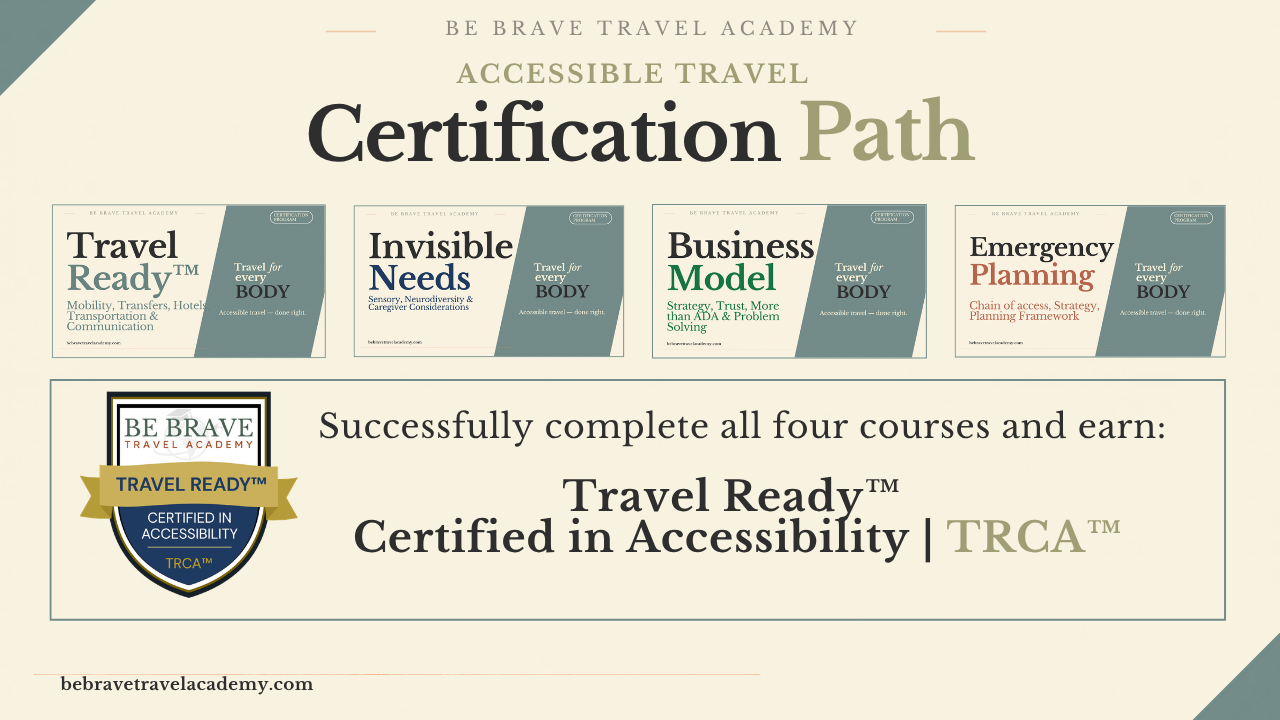
Course 2 of 4 toward full certification.
Each course builds the next layer.
Invisible Needs picks up exactly where Travel Ready™ leaves off — moving from physical accessibility into the factors that no checklist can capture.
All are available at presale pricing until July 4th.
Course 1
Travel Ready™
Learn the fundamentals of accessible travel planning, including mobility, transfers, hotel usability, transportation, and inclusive communication.
Course 2
Invisible Needs
Understand the hidden barriers many travelers face, including sensory needs, neurodivergence, chronic illness, fatigue, and caregiver considerations.
Course 3
Business Model
Learn how to build trust, attract underserved clients, create inclusive marketing, and develop systems that lead to stronger relationships and more referrals.
Course 4
Emergency Planning
Learn how to anticipate challenges, protect travelers, and confidently respond when plans change.
Best Value — Founding Bundle
Get all 4 courses &
full TRCA™ certification.
Lock in every course in the certification series at the founding price — including courses not yet released. When the full Trave Ready™ Certificatied in Accessibility pathway launches, you're already in.
$188
$499 after July 4th
Save $89 vs. buying individually
Lifetime access to all 4
$47
Everything included:
Price increases to $147 on July 4th.
Founding cohort price will not return.
Before you go —
Do I need to take Travel Ready™ first?
I already took Travel Ready™. Is this completely different content?
Do I need a medical background to understand this?
What is the TRCA™ and when will it launch?
The needs you couldn't see
were the ones ending the trip.
Now you'll see them.
Invisible Needs gives you the clinical framework to plan for fatigue, sensory overwhelm, and caregiver sustainability — before your clients have to tell you something went wrong.