
Successful accessible travel isn’t determined
by whether something goes wrong.
It’s determined by what happens next.
For travelers with disabilities, a “minor inconvenience” can quickly become a major accessibility crisis.
This course teaches you to plan for failure before departure — so when something goes wrong, you already know exactly what to do.
Built by occupational therapists over 20 years of clinical experience.
Includes lifetime updates to Travel Ready™: Emergency Planning
These aren’t rare events.
They’re Tuesday.

"The power wheelchair joystick snapped during unloading."
Before this course: panic. After: photograph, request the CRO, activate the equipment Go-Bag, call the repair vendor you already identified.
"The hotel’s only elevator stopped working. Our client is on the sixth floor."
A single elevator is a single point of failure. This course teaches you to identify them before your client checks in.
"The accessible van never showed up. Cruise boarding closes in 45 minutes."
The Last Mile Gap. Every transition in an itinerary needs its own backup. This course shows you how to build them.
"The accessible room we booked was given to someone else."
The Rule of Two: every critical need requires a backup. If there’s only one way to accomplish something, there isn’t really a plan.
Includes lifetime updates to Travel Ready™: Emergency Planning
For most travelers, a broken elevator is an inconvenience. For a traveler who cannot use stairs, it’s a barrier that can end the trip entirely. The stakes of accessible travel failures are categorically different.
Travel Ready™: Emergency Planning is the final course in the TRCA series because it only works when you have the clinical and business foundations underneath it. This is where everything comes together — the frameworks that turn unexpected failures into manageable problems, the systems that protect participation, and the mindset that earns client loyalty for life.
Problems don’t create loyalty. How those problems are handled does.
Includes lifetime updates to Travel Ready™: Emergency Planning
The proprietary frameworks at the heart of this course:
Three systems that turn crisis into protocol.
The A.C.T. Emergency Response Framework
When something goes wrong, respond with protocol — not panic.

Before solving the problem, understand exactly what happened. Photograph damage. Record names and times. Save receipts and written communication.
Power chair damaged at the airport? Photograph before leaving the gate. Request the Complaint Resolution Official (CRO) immediately.

Activate the backup plans you built before departure. If the transfer didn’t show, call the secondary provider. If the room is unusable, contact the backup property.
Preparation only becomes valuable when those resources are actually used. This step is where planning pays off.

You don’t solve every problem alone. Bring travel insurance, suppliers, family, caregivers, local vendors, and medical providers into the situation. Each contributes differently.
No one person is responsible for solving everything. The goal is connecting the right people and allowing each to contribute their expertise.
Includes lifetime updates to Travel Ready™: Emergency Planning
Framework 2
The Rule of Two.
Every critical need requires a backup. If there is only one way to accomplish something — there isn’t really a plan.
Building Redundancy Into Every Itinerary
Professional emergency planners live by one principle: if it only works once, it doesn’t work.
Transportation
Lodging
Equipment
Medications
Includes lifetime updates to Travel Ready™: Emergency Planning
Framework 3
Risk Architecture
Every itinerary has weak points. Your job is finding them first.
01 Risk Area
Single-Point Failures
Anything with no backup that, if it stops working, stops the trip. One elevator. One accessible room. One wheelchair lift. One accessible van.
"If this becomes unavailable today — what is Plan B?" If the answer is there isn’t one, you’ve identified a major risk.
02 Risk Area
The Last Mile Gap
Itineraries often cover the major components — flight, hotel, excursions — and fail during the connections between them. Airport to hotel. Hotel to cruise port. Port to excursion.
Every transition deserves its own accessibility plan: primary transport, backup, emergency. With phone numbers and reservation procedures.
03 Risk Area
Equipment Vulnerability
Mobility equipment is loaded, unloaded, lifted, stored, and moved multiple times during travel. Joysticks, footrests, chargers, battery connectors — each is a potential failure point.
Assume equipment will be handled roughly. Prepare accordingly. This course teaches you to build an equipment Go-Bag that covers every scenario.
04 Risk Area
Environmental Stressors
Sand, cobblestones, steep inclines, heat, humidity — environments place additional stress on equipment and on the traveler’s energy reserves simultaneously.
Don’t just ask “Is it accessible?” Ask “Will this environment support the traveler’s equipment and energy needs throughout the entire experience?”
Includes lifetime updates to Travel Ready™: Emergency Planning
The “What If?” Framework
This question doesn’t come from fear. It comes from preparation.
What could happen?
Review every stage of the itinerary. What if the transfer doesn’t arrive? The elevator breaks? The accessible room isn’t available? The traveler becomes fatigued? Equipment is damaged?
What would the impact be?
Not every problem has the same consequences. Would this inconvenience the traveler, or would it stop participation altogether? Understanding impact determines which issues deserve the most attention.
What is Plan B?
What backup resources are available? Who could help? Alternative transport, accessible rooms, local repair vendors, support systems — a good backup plan prevents one challenge from ending the entire experience.
Communicate expectations.
Preparation isn’t only about having a backup. It’s about helping travelers understand that unexpected things happen — and that there is a plan when they do. Travelers don’t need perfection. They need confidence.
Includes lifetime updates to Travel Ready™: Emergency Planning
🚨Travel Ready™: Emergency Planning Course & Frameworks (Value: $147)
Learn the A.C.T. Framework, Rule of Two, and "What If?" system that turns unexpected accessibility failures into manageable problems with a clear path forward.
🎒 Equipment Go-Bag Complete Guide (Value: $97)
Every tool, spare part, charger, and document your client needs to handle equipment failures without ending the trip — including the laminated Quick Recovery Card template.
🗺️ Destination Resource Research Guide (Value: $97)
Know exactly where to find mobility repair vendors, specialized medical facilities, and equipment suppliers at any destination — before your client ever needs them.
Total Value: $538+
Price: $147
Includes lifetime updates to Travel Ready™: Emergency Planning
This wasn't built by advisors
who learned about disability.
It was built by clinicians.
April spent 11 years as a COTA/L in skilled nursing and rehabilitation — where anticipating barriers before they affect participation isn’t a strategy, it’s the job. The emergency planning mindset in this course is the same clinical thinking she applied every day in practice, translated for travel advisors who need to protect their clients the same way.
Michelle brings 11 years of OT practice alongside personal experience that goes far beyond the clinical. She understands what it means to be the person in the support system — the one who has to stay calm, stay organized, and stay focused on participation when everything else is falling apart. That perspective is woven into every lesson in this course.
Includes lifetime updates to Travel Ready™: Emergency Planning
Why OT credentials matter specifically for invisible needs
Fatigue management, sensory processing, caregiver dynamics — these aren't topics occupational therapists learned about. They're core clinical disciplines we practiced daily for over a decade. This course doesn't add those topics to travel training. It builds travel training from those disciplines up.
Course 4 of 4 toward full certification.
Each course builds the next layer.
Invisible Needs picks up exactly where Travel Ready™ leaves off — moving from physical accessibility into the factors that no checklist can capture.
All are available at presale pricing until July 4th, 2026.
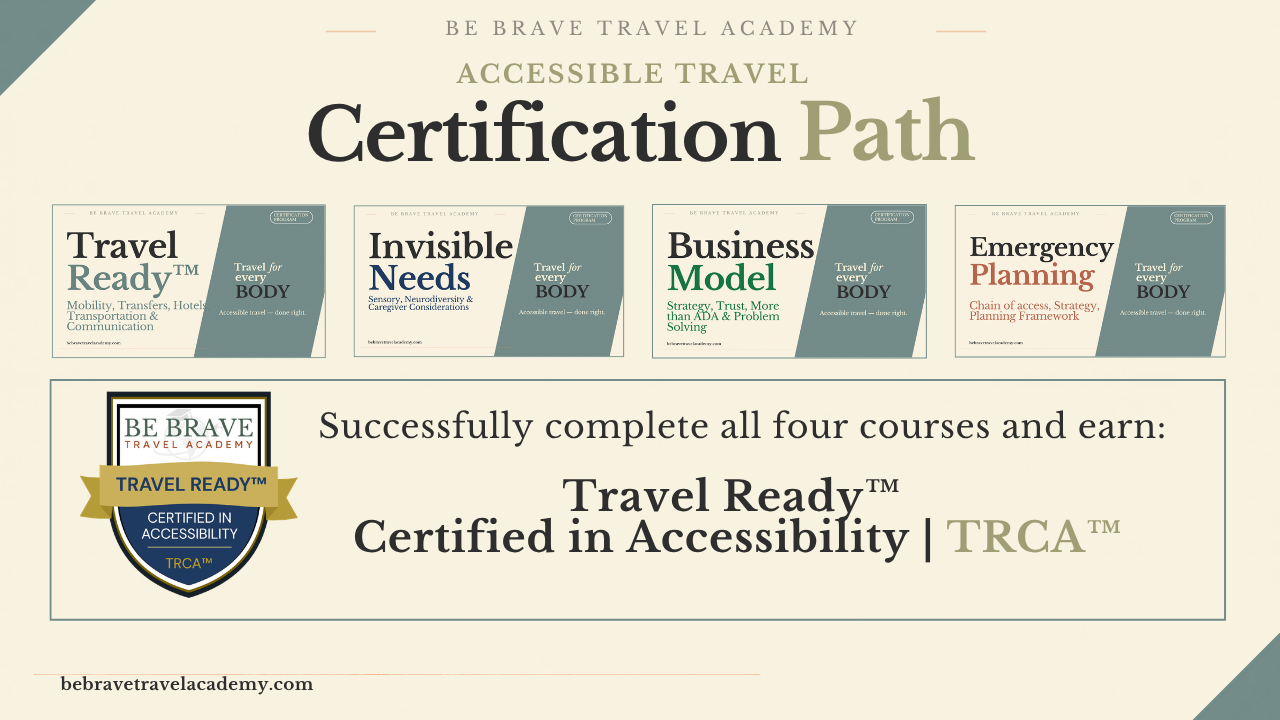
Course 1
Travel Ready™: Foundations
Learn the fundamentals of accessible travel planning, including mobility, transfers, hotel usability, transportation, and inclusive communication.
Course 2
Travel Ready™:
Invisible Needs
Understand the hidden barriers many travelers face, including sensory needs, neurodivergence, chronic illness, fatigue, and caregiver considerations.
Course 3
Travel Ready™:
Business Model
Learn how to build trust, attract underserved clients, create inclusive marketing, and develop systems that lead to stronger relationships and more referrals.
Course 4
Travel Ready™:
Emergency Planning
Learn how to anticipate challenges, protect travelers, and confidently respond when plans change.
Best Value — Founding Bundle
Get all 4 courses &
full TRCA™ certification.
Lock in the four courses in the certification series (shown on right) at the founding price. When the full Travel Ready™ Certificatied in Accessibility pathway launches, you're in.
$588
Includes lifetime updates to the four Travel Ready™ courses
$147
Everything included:
Includes lifetime updates to Travel Ready™: Emergency Planning
Before you go —
Do I need to take Travel Ready™ first?
I already took Travel Ready™. Is this completely different content?
Do I need a medical background to understand this?
What is the TRCA™?
Is this course only relevant for travelers with wheelchairs?
Do I receive lifetime updates?
Does this include future courses?
Travelers may forget the details of the disruption.
They rarely forget who stood beside them through it.
Travel Ready™: Emergency Planning gives you the frameworks, the systems, and the mindset to be that advisor — the one who responds with protocol instead of panic, and builds client loyalty in the moments nobody planned for..